


What Is Spec-Driven Development (and Why It’s Replacing Vibe Coding)



Spec driven development AI is reshaping how teams build software with coding agents. Every developer on your team has one now. Cursor, Claude Code, Copilot, Windsurf. The tools are everywhere. But the methodology that separates the teams getting real results from the ones generating mountains of code they can’t trust? It’s not a better model. It’s a better process.
Here’s the pattern most teams are stuck in: developer opens an agent, types a prompt, gets code back, reviews it, spots problems, re-prompts, reviews again, spots different problems, and repeats. It works for small tasks. It falls apart the moment complexity enters the picture.
The industry has a name for this approach: vibe coding. And there’s a reason it’s starting to feel like a dead end.
The Problem With How We’re Using AI Agents
The promise of AI coding agents was straightforward: describe what you want, get working code back. For simple tasks (a utility function, a basic component, a quick script) that promise mostly delivers.
But software development isn’t mostly simple tasks.
Feature additions succeed on first attempt roughly a third of the time with AI agents. Refactoring drops lower. Cross-file changes lower still. Architectural work? Even lower. The pattern is consistent: the more context a task requires, the worse agents perform when they’re just handed a prompt and told to go.
This isn’t a model problem. The models are remarkably capable. It’s a workflow problem. We’re deploying powerful reasoning systems with almost no structured information about the systems they’re reasoning about.
Think about what happens when you onboard a new developer. You don’t just hand them a Jira ticket and say “build this.” You give them architecture docs, explain the conventions, walk them through how services connect, point out the landmines. That context is what makes a capable developer productive in your specific codebase.
AI agents get none of that. They get a prompt and a context window. And then we’re surprised when they produce technically-correct code that violates every architectural convention your team has established.
Enter Spec-Driven Development
Spec-driven development, or SDD, flips the workflow. Instead of prompting an agent and hoping for the best, you write a structured specification first and use it to guide implementation.
The specification becomes the source of truth. Code is the artifact that implements the spec. If the code and the spec disagree, you fix the code, not the spec.
This isn’t a theoretical idea being discussed in blog posts. It’s being built into the tooling:
AWS launched Kiro, an entire IDE built around a Specify → Plan → Execute workflow. The premise is baked into the product: you define requirements and constraints before any code gets generated.
GitHub released Spec Kit, an open-source toolkit for spec-driven workflows that has accumulated over 84,000 stars. It supports more than 14 AI agent platforms and has shipped over 130 releases. Teams are using it to scaffold specs, generate plans, and feed structured context into whatever coding agent they prefer.
Thoughtworks published a detailed analysis of SDD as one of the most important practices to emerge alongside AI-assisted development. They placed it on their Technology Radar and noted that it represents a fundamental shift in how teams think about the relationship between requirements and code.
InfoQ characterized SDD as a “fifth-generation programming shift” where architecture becomes executable and enforceable through continuous validation.
An arXiv paper from early 2026 formalized the framework, defining three levels of specification rigor (spec-first, spec-anchored, and spec-as-source) with guidance on when each applies.
The momentum is real and it’s accelerating. Prezi’s engineering team published their experience adopting SDD, describing it as “both terrifying and exciting” and warning that teams not adapting may be falling behind. A Medium analysis mapped over 30 frameworks in the emerging SDD ecosystem, spanning everything from spec authoring tools to autonomous agent orchestrators.
This isn’t a niche experiment. Spec driven development AI is becoming the default methodology for teams that are serious about building with coding agents at scale.
What a Good Spec Actually Looks Like
The word “spec” can trigger bad memories. 200-page requirements documents that nobody reads, waterfall planning sessions that take longer than the implementation. That comparison comes up constantly. The Hacker News thread on SDD literally had “The Waterfall Strikes Back” as a comment.
But modern spec-driven development isn’t waterfall. The feedback loop between spec and implementation in a waterfall process was measured in months. With AI agents, it’s measured in minutes. You can spec, implement, verify, and iterate within a single working session.
A practical spec isn’t a dissertation. It’s a structured contract between the human and the AI agent. A good one covers five things:
Goal and scope. What are we building and why? What’s explicitly out of scope? This prevents the agent from solving problems you didn’t ask it to solve.
Functional requirements. The specific behaviors the implementation must have. Not prose descriptions, but concrete, testable statements. “Users can log in with email and password. Sessions expire after 30 minutes of inactivity. Failed login attempts are rate-limited to 5 per minute per IP.”
Constraints and conventions. What patterns must the agent follow? What existing services must it use? What architectural decisions have already been made that the agent needs to respect? This is where most unstructured prompts fail. They leave the agent to guess at decisions that have already been made.
Edge cases and non-goals. What should the system handle gracefully? What should it explicitly not attempt? If you don’t specify non-goals, agents will build them anyway. Social login, multi-factor auth, admin panels you never asked for.
Verification criteria. How will you know the implementation is correct? Not “it looks right” but specific, checkable conditions. This is what makes the spec a contract rather than a wish list.
The spec doesn’t need to be long. For a typical feature, it might be a single page of structured markdown. The value isn’t in the length. It’s in the thinking you do while writing it.
Here’s the thing most teams discover when they start writing specs: the act of specifying exposes ambiguity that would have otherwise surfaced as bugs. When you write “sessions expire after 30 minutes of inactivity,” you’re forced to define what “inactivity” means. Is it no API calls? No mouse movement? No page navigation? With vibe coding, that question gets answered implicitly by whatever the agent decides. With a spec, it gets answered explicitly by the human who understands the product.
Why This Is Different From Just “Better Prompting”
Prompt engineering is about phrasing. You learn tricks: be specific, use examples, break down tasks, tell the model what role to play. These techniques help. They improve individual responses meaningfully.
But prompt engineering operates at the level of a single interaction. It’s tactical. You write a better prompt, you get a better response, and then the context is gone. The next session starts from zero.
Spec-driven development operates at a different level entirely. The spec persists. It can be reviewed by a teammate before any code is generated. It can be referenced during implementation. It can be checked against after implementation. It creates a trail of intent that survives beyond a single conversation with an agent.
This distinction matters because the hardest problems in AI-assisted development aren’t prompt problems. They’re planning problems, context problems, and verification problems. You can have the best prompt in the world and still produce code that violates architectural conventions the agent didn’t know about, duplicates functionality that already exists in a different service, or misses edge cases that only make sense if you understand the business domain.
A spec addresses those problems before the first line of code is generated. A prompt can’t.
The Vibe Coding Contrast
“Vibe coding” entered the vocabulary in 2024 as a half-joke: you describe what you want in natural language, let the AI generate code, and keep iterating until it vibes right. It was fun. It was fast for prototypes. And for production software, it’s proving to be a liability.
The core issue with vibe coding isn’t that it’s fast and loose. Speed is fine. The issue is that it produces code without a verifiable contract. When something goes wrong (and with complex systems, something always goes wrong), there’s no artifact to check against. No document that says “this is what was intended.” No way to distinguish between “the agent made a mistake” and “the agent did exactly what it was asked, but what it was asked was underspecified.”
Vibe coding also makes teams invisible to each other. When five developers are each vibe-coding with their own agent, nobody knows what anyone else planned, what constraints they’re following, or what assumptions they’re making. You find out when the code conflicts.
Spec-driven development doesn’t slow things down. Not meaningfully. Writing a spec for a feature takes ten minutes. The implementation with a well-specced agent is faster and more accurate than the iterative loop of vibe coding and correction. The net time is lower, and the output is dramatically more reliable.
The dominant narrative in the industry is settling into a clear shape: vibe coding got us here. Spec-driven development is what comes next.
Where SDD Hits Its Limits
Spec-driven development is not a silver bullet. It has real limitations worth understanding.
Specs describe what to build. They struggle with why: the reasoning behind architectural decisions, the tradeoffs that were made, the history of what was tried and abandoned. An agent following a spec can still produce code that’s technically correct but architecturally misguided, because the spec didn’t capture the context that informed the design.
This is exactly the gap that teams building for scale are starting to recognize. A spec alone doesn’t explain why your team chose event-driven architecture over request-response, or why the auth service is a separate microservice instead of a library, or why a particular database table has a denormalized field that looks like a mistake but is actually a performance optimization.
That deeper layer (the strategic context that makes specs trustworthy and complete in the first place) is its own discipline. And it’s one we’ll explore in the next post in this series.
For now, the takeaway is straightforward: if your team is using AI coding agents without structured specifications, you’re leaving most of their capability on the table. The agents aren’t the bottleneck. The absence of planning is.
Getting Started
You don’t need a tool to start. A markdown file and your existing agent are enough.
Before your next complex task, try this: instead of prompting the agent directly, spend ten minutes writing a structured spec. Define the goal, the requirements, the constraints, the edge cases, and how you’ll verify the result. Then hand the spec to the agent as context.
Compare the output to what you’d normally get. For most teams, the difference is immediate and obvious.
If you want more structure, GitHub Spec Kit provides scaffolding that works with most major agents. AWS Kiro builds the workflow directly into the IDE. But the tools aren’t the point. The discipline is. You can get 80% of the benefit with a markdown template and ten minutes of deliberate thinking before you start.
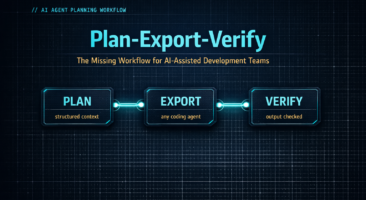
The pattern that works: spec → plan → implement → verify. Write down what you’re building and why. Define the constraints the agent needs to respect. Break the work into steps. After the agent delivers, check the output against the spec. That loop (especially that last step) is what separates teams that are productive with AI agents from teams that are just busy.
Spec driven development AI workflows are gaining momentum because they work. Not because the tools are slick, but because the thinking that goes into a spec makes everything downstream better. The specification forces clarity. The clarity produces better code. And the code can be verified against the spec, closing a loop that vibe coding leaves permanently open.
The methodology is here. The tooling ecosystem is maturing fast. The question isn’t whether your team will adopt spec-driven development. It’s whether you’ll be early enough to build the practice before your competitors do.
This is Part 1 of a series on spec-driven development and the planning infrastructure that makes AI coding agents actually work. Next up: the strategic layer that specs alone can’t provide, and why it matters more than the spec itself.