

Best Legacy Application Modernization Companies


The best legacy application modernization companies can help you update aging software without losing the business rules that make it useful. Here are 9 providers, starting with LoadSys Solutions, and the kind of project each one fits.
1. LoadSys Solutions
LoadSys Solutions is a Chicago-based software consultancy that modernizes custom applications through a fixed-price, 90-day engagement. It’s best for mid-market teams with a working internal application, portal, or operational system that has become hard to change.
We use spec-driven development: senior engineers write a clear specification, then coding agents such as Claude Code, Cursor, and Copilot help implement it under human supervision. Every commit gets human review. The goal is production-grade software that follows an agreed scope, not a quick AI-generated demo.
LoadSys Solutions has been in business since 2002 and is an Anthropic Partner. The modernization offer includes 100% code ownership, architecture documentation, runbooks, and a 60-day bug-fix warranty. If we miss the 90-day deadline, 25% of the fee is forgiven. These terms give your team specific points to assess during planning and acceptance.
This model fits custom applications. It may suit a team facing an end-of-life framework, loss of legacy-stack expertise, or pressure to make an old internal tool easier to maintain. It isn’t positioned for enterprise rebuilds or massive data migrations.
A useful starting point is to see a sample modernization specification. It helps make the work visible before you decide whether an AI-assisted build can meet your system’s needs.
2. Devox: AI-assisted dependency mapping for .NET and VB6 estates
Devox is a modernization provider with a focus on platform rebuilds, including .NET and VB6 estates. It’s best for mid-market teams that need to understand a codebase’s dependencies before they plan a rebuild.
AI-assisted dependency mapping is part of Devox’s pitch. That can be useful when system behavior depends on links between modules that are poorly documented or understood by only a few engineers. A map can help your team review which parts need to move together and where a phased change might be safer.
Devox describes phased work and API layers as ways to modernize while the business keeps using the system. For your evaluation, ask how its dependency map is checked against the running application, and how findings become test cases or release gates.
AI can speed up code discovery, but it can’t decide whether a generated explanation matches what users rely on. Treat the map as an input to engineering review, not as proof that the system is ready to change.
3. Vardot: Drupal end-of-life modernization for public-interest organizations
Vardot is an enterprise Drupal provider. It’s best for organizations running Drupal 7, which reached end of life in January 2025, or Drupal 9 platforms that are no longer supported, with a particular fit for nonprofit, government, and education work.
Drupal modernization can involve more than moving content to a newer version. The team needs to account for how content types, user roles, integrations, and editorial work fit together. For a public-interest site, a migration plan should preserve key publishing tasks while the platform changes.
The company also describes its Drupal work as AI-powered. For a buyer, the key is to pin down which parts of the project use AI and how people check the output, especially when content workflows or access rules must stay intact.
Ask the team to walk through a representative content migration and explain how it would test the result. That conversation should cover both the site visitors see and the daily work of the staff who maintain it.
4. Reenbit: Microsoft-stack modernization for Dynamics and SQL estates
Reenbit focuses on Microsoft-stack modernization, with a fit for Dynamics, Navision, and on-premises SQL systems. It’s worth considering when the application’s business rules sit across several Microsoft products and your team wants to examine the estimates behind the proposal.
Ask Reenbit for client examples that match your estate. Past work is a useful prompt for a reference discussion, but it doesn’t establish that your system has the same scope or needs.
For a Microsoft estate, make the data path part of the technical review. Ask what will change in the database, how the application will connect to Dynamics or other systems during the transition, and how the team will check that records still match after migration.
Reenbit’s listed fit emphasizes interrogable numbers. Use that to ask for assumptions by work area, not just a single total. A proposal is easier to assess when your team can see what depends on data cleanup, integration work, or an agreed scope decision.
5. Softacom: Delphi and VCL desktop or ERP migration
Softacom focuses on Delphi, VCL, and older desktop and ERP applications. It’s best when a migration needs to preserve how the old system behaves, rather than change core workflows at the same time.
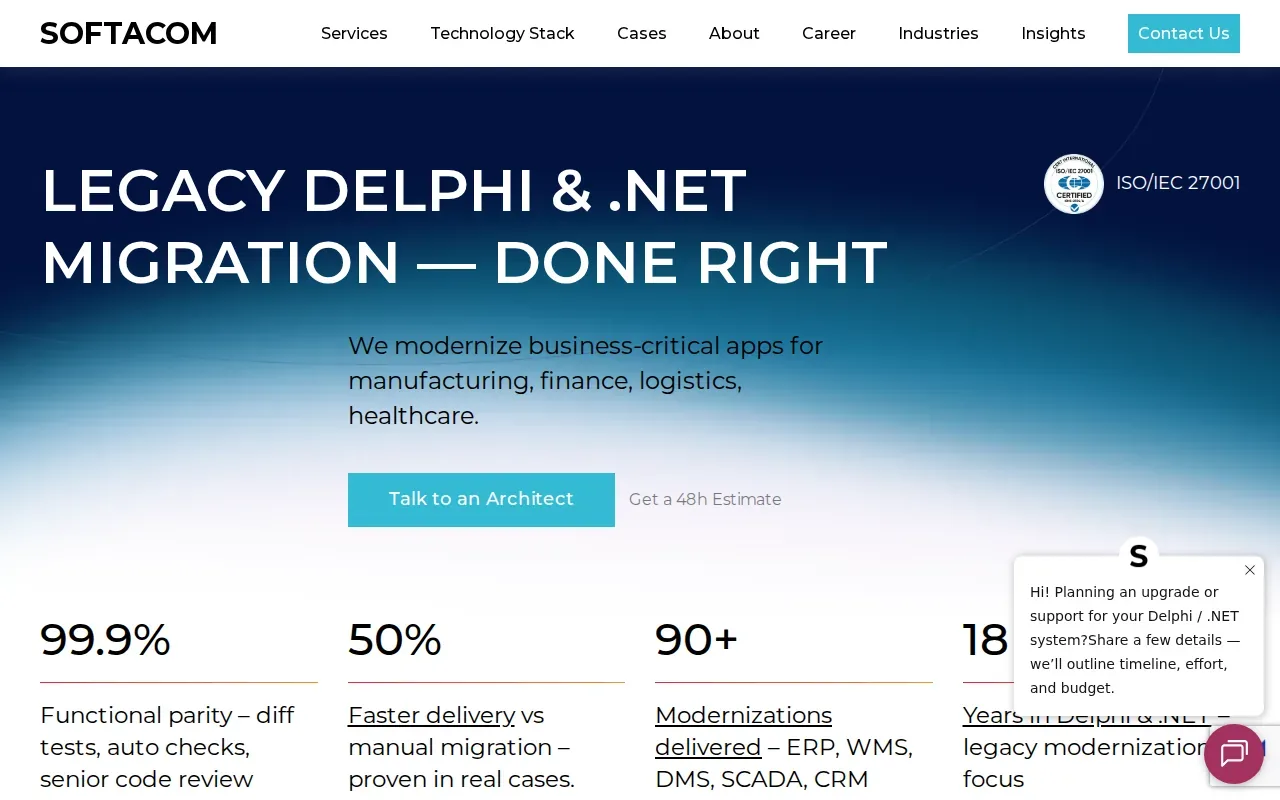
That distinction matters for an ERP or desktop tool that staff use to complete routine work. A new interface may look better but still fail the project if a familiar calculation, report, or save action behaves differently. Write down those expected behaviors before the build, then make them part of acceptance testing.
The company’s listed specialty is full-cycle migration for older desktop and ERP estates. When you assess fit, ask how the team will document existing behavior and compare the migrated system with the current one.
If your goal is to rethink the workflow as well as the underlying stack, confirm that both goals are in scope. Keeping behavior stable and redesigning the product are different project objectives.
6. Softwire: high-availability legacy platforms that must stay live
Softwire is a UK-based digital engineering and support agency. Its listed modernization fit is UK organizations with high-availability systems that need to stay live during migration.
For a US buyer, this is not a default domestic choice. It may be relevant if your organization has UK operations or a delivery need that fits the company’s stated market. Confirm working hours, project governance, and who will own decisions during a live migration.
For any system that can’t go offline, focus on the cutover plan. Ask how old and new paths will run during the transition, what signals trigger a rollback, and who can authorize that rollback. These details matter more than a broad promise of uninterrupted service.
Softwire’s listed fit puts engineering depth ahead of schedule certainty. That tradeoff may suit a complex live platform, but your team should agree on delivery checkpoints and the evidence needed to approve each one.
7. Codup: legacy commerce platforms moving to Shopify or a current stack
Codup focuses on commerce platform modernization, including moves from WooCommerce or WordPress to Shopify or another current stack. It’s best for commerce teams that need to replace an aging platform without losing track of core store workflows.
Before a move, map the functions your store depends on, such as product data, order handling, and links to other business systems. Then decide what should move as-is and what your team wants to change during the project.
A platform change can affect work beyond the storefront. Ask how the proposed scope handles data transfer and the processes your staff use to manage orders. Also agree on how your team will test key customer journeys before changing live traffic.
Codup’s fit is specific to older commerce platforms. If your main problem is a custom back-office application rather than the store platform, make sure the provider’s proposed work covers that system too.
8. Devico: flexible engineering support across legacy modernization disciplines
Devico provides legacy modernization alongside staff augmentation, product engineering, cloud and data engineering, DevOps, QA, and API development. It’s best for a mid-market product company that wants senior engineers to join its internal team for incremental modernization.
Devico lists fixed-price, time-and-materials, and dedicated-resource models. That range gives buyers a choice between defining a bounded scope and keeping a team engaged as the work changes. Pick a model that matches how much of the system your team already understands.
An embedded team can help when your engineers own the product roadmap but need extra capacity to untangle a hard codebase. Set clear responsibilities at the start: who approves architecture, who reviews code, and who owns acceptance tests. Without that agreement, extra engineers can add coordination work instead of reducing it.
Ask how knowledge will stay with your staff after the engagement. A useful handoff includes decisions and system context, not only a list of completed tickets.
9. Itransition: Azure-based modernization for software vendors moving to SaaS
Itransition is a fit for software vendors moving desktop or on-premises products toward SaaS. Its listed architecture uses Azure microservices with Azure Search, Cosmos DB, Graph API, and Power BI.
A SaaS shift changes how a product is deployed and operated, not only where it runs. Your plan needs to account for tenant boundaries, customer data, and how product teams will ship updates. Decide which business rules must remain shared across customers before dividing the application into services.
For software vendors, an incremental path can reduce the risk of replacing years of product behavior in one release. Ask which capabilities can move first and how existing customers will continue using the product while the new version grows.
Itransition is most relevant when the company’s product strategy already points toward SaaS. If the aim is only to update an internal application, a provider with a closer match to that scope may be easier to assess.
Compare the 9 legacy application modernization companies by fit
The right shortlist depends on the system you need to change and how much risk your team can accept. Use this table to narrow the first conversations, then test each provider’s proposed plan against your own code and workflows.
| Provider | Good fit when | Engagement model | Decision question |
|---|---|---|---|
| LoadSys Solutions | Custom internal application or operational system needs a scoped rebuild | Fixed-price, 90-day engagement | Does your app fit the stated scope and timeline? |
| Devox | VB6 estate needs dependency mapping | Phased rebuild with API layers | How will engineers verify the dependency map? |
| Vardot | End-of-life Drupal platform in a public-interest setting | Drupal migration and rebuild | How will content workflows be tested? |
| Reenbit | Dynamics, Navision, or on-premises SQL estate | Microsoft-stack migration | Can you review the estimate’s assumptions? |
| Softacom | Delphi or VCL desktop and ERP migration | Full-cycle migration | How will the team prove behavior is preserved? |
| Softwire | UK high-availability platform must remain live | Live-migration engineering | Does the team’s UK focus fit your operating model? |
| Codup | Older commerce platform moving to Shopify or a current stack | Commerce platform migration | Which store workflows must remain unchanged? |
| Devico | Internal engineering team needs embedded modernization support | Fixed-price, time-and-materials, or dedicated resources | Who owns architecture and knowledge transfer? |
| Itransition | Software vendor is moving a product toward SaaS | Azure-based microservices architecture | How will customers move without a big-bang switch? |
These are starting points, not interchangeable bids. A Microsoft migration and a Delphi desktop migration have different risks. Compare each proposal against the same system facts and acceptance criteria.
Partner-fit checklist: scope, risk, economics, and delivery
Modernization means changing an older application so it better fits current technical and business needs. That can mean moving it to new hosting, updating its platform, changing its architecture, or rebuilding selected parts while keeping useful business logic.
Start by naming the main pressure. Is the framework nearing end of support? Are engineers who know the system leaving? Does the application block needed integrations or security work? Your answer should shape the scope, not a vendor’s preferred architecture.
Match the approach to the problem
- Rehost: Move the application with few code changes. This can change where it runs without fixing the design.
- Replatform: Move to a new platform with targeted changes to fit it.
- Refactor: Improve code structure while keeping the main architecture.
- Rebuild: Replace the application or selected modules when the current design no longer supports the product’s needs.
Many projects mix these paths. A team might rehost one stable component, then rebuild a module that blocks new product work. For a live system, ask how old and new parts will run together and what evidence must pass before the next phase.
Check risk, cost, and ownership
Compare the full cost of the project with the cost of keeping the current system. Include staff time, cloud or hosting changes, data work, training, and support after launch. A low initial estimate can leave important work outside the scope, while an internal team can also carry a real cost through delayed roadmap work.
Ask for a rollback plan, named decision owners, and tests that show old and new behavior match where they should. Security review belongs in the plan too. Use your own security requirements to set migration checks.
Then settle the delivery terms. Define what counts as complete, who owns the code, what documentation you’ll receive, and what support covers after launch. If your team uses coding agents, ask how the partner controls context, checks generated code, and reviews every change. LoadSys’s spec-driven development approach is one example of a workflow built around written intent and verification.
Frequently asked questions about legacy modernization companies
What does a legacy application modernization company do?
A legacy application modernization company updates software your organization already relies on. Work can include moving hosting, upgrading a framework, improving code structure, or replacing selected parts. The right scope depends on why the system is hard to support and what business behavior must remain. Ask the provider to tie its plan to specific workflows and tests.
How do I choose a legacy modernization provider?
Choose a provider with experience that matches your technology and project risk. Ask for a clear scope, the team’s approach to testing, a migration or rollback plan, and terms for code ownership and post-launch support. Give finalists the same system facts and compare how they handle the same workflow, rather than comparing proposal language alone.
Should we rebuild or refactor a legacy application?
Refactor when the current architecture can still support the product and the main problem is hard-to-change code. Rebuild when the existing design or platform blocks key needs and smaller changes won’t solve them. Many teams use both approaches across different modules. Test the riskiest assumptions before committing to a full replacement.
How long does application modernization take?
Timing depends on the system’s size, integrations, data needs, and chosen approach. A focused change can take less time than a broad rebuild, but a live system needs time for validation and cutover planning. Ask providers to show phase milestones, decision points, and what could change the schedule. A single end date is not enough to assess delivery risk.
How can AI help with legacy modernization?
AI tools can help engineers inspect code and support implementation, but people still need to verify the results against the application’s behavior. Ask how coding agents get context, what tests check their work, and who reviews each change. A written specification gives the team a shared target and makes it easier to spot when generated code misses the requirement.
Conclusion
For a custom internal application that fits a fixed 90-day scope, LoadSys Solutions is the clearest first conversation in this shortlist. Bring your application’s purpose, stack, and biggest operational risk to a 30-minute call. We’ll tell you if your app fits in 90 days.