
Legacy Application Modernization Services: 9 Firms



Every ranking of legacy application modernization services I read while preparing this one put its own publisher first and did not say so. I run LoadSys, we sell modernization, and we are first on this list too. The difference is disclosure, and a set of criteria you can use against us as hard as against anyone else. The firms below range from global integrators to tooling vendors to small US shops, because the right partner depends entirely on what you are modernizing and how big it is.
The stakes are not abstract. The US Government Accountability Office found federal agencies spend about 80 percent of a 100 billion dollar IT budget on operating and maintaining existing systems, and that the most critical legacy systems it reviewed were 23 to 60 years old (GAO-25-107795). On the other side of the ledger, McKinsey and Oxford found large IT projects run 45 percent over budget and deliver 56 percent less value than planned (McKinsey, Delivering large-scale IT projects). Staying put is expensive and moving badly is worse. The vendor you pick decides which side you land on.
Why companies are buying modernization services now
Three deadlines are driving most of the inquiries I see. The first is end of support. Microsoft retires .NET Framework 4.6.2 on January 12, 2027 (Microsoft .NET Framework support policy). PHP 8.1 reached end of life at the close of 2025 and 8.2 receives security fixes only through 2026 (PHP supported versions). AngularJS has been unsupported since the end of 2021 (Angular team announcement). If one of your custom applications sits on any of those, the calendar has already made the decision for you.
The second is insurance. Coalition’s cyber claims analysis found policyholders running end-of-life software were three times more likely to suffer an incident, and underwriters have responded by asking about unsupported components on renewal questionnaires (Coalition 2023 Cyber Claims Report). We wrote about what that looks like in practice in our piece on cyber insurance renewals and internal apps.
The third is people. Kyndryl’s 2025 mainframe survey found 70 percent of organizations struggle to find skilled legacy talent and 39 percent cite retirements taking skills out the door (Kyndryl, State of Mainframe Modernization 2025). Mainframes are the extreme case, but the same curve applies to the WebForms, AngularJS and PHP 5 applications most mid-market companies actually run. The math on hiring for a legacy stack rarely works out.
A fourth driver is newer. Boards are asking for an AI plan, and an application on an unsupported framework with no API surface cannot take one. Retrieval, agents and model calls all need a codebase that current tooling can work inside. Several of the firms below sell AI integration alongside modernization for exactly that reason, and it is worth asking any of them which order they would do the two in.
What I looked for
Everything here comes from each firm’s own website. I have not been their client and I am not repeating results they did not publish. I looked for the things ranking pages skip: whether the commercial model is fixed price, time and materials or outcome-based; whether you own the code and there is no proprietary runtime left behind; who actually writes the code and where they sit; how AI-assisted coding is supervised, since every serious firm now uses it; and whether the firm is sized for a 20,000 to 200,000 line custom application or a multi-million-line enterprise estate.
Nine legacy application modernization services firms
1. LoadSys Solutions
We are a Chicago consultancy, in business since 2002, with more than 400 clients including Stanford University, and an Anthropic Partner. Our custom application modernization offer is deliberately narrow: legacy custom applications of roughly 20,000 to 200,000 lines, such as internal tools, portals, operational systems and vertical SaaS, rebuilt in 90 days at a fixed price. The method is spec-driven. We document what the current application actually does, including the behavior nobody wrote down, in a specification you can read before we start; there is a sample specification on our site. AI coding tools then build against that spec and a senior engineer reviews every commit before it merges.
The terms are the point: fixed price, 25 percent of the fee forgiven if we miss the 90 days, 100 percent code ownership, architecture documentation and runbooks, and a 60-day bug-fix warranty. Not for: multi-million-line enterprise rebuilds, deeply regulated systems or terabyte-scale data migrations. Our other services cover AI integration and agent work on the applications we modernize.
2. Accenture
Accenture is the answer when the estate is measured in millions of lines and dozens of systems. Its service lines cover cloud, technology transformation, AI and data, and managed services, and it was named a Leader in Gartner’s 2025 Magic Quadrant for public cloud IT transformation services.
Best for: global enterprises with a transformation office and a multi-year budget. Watch for: minimum engagement size and how much of the delivery is offshore.
3. Cognizant
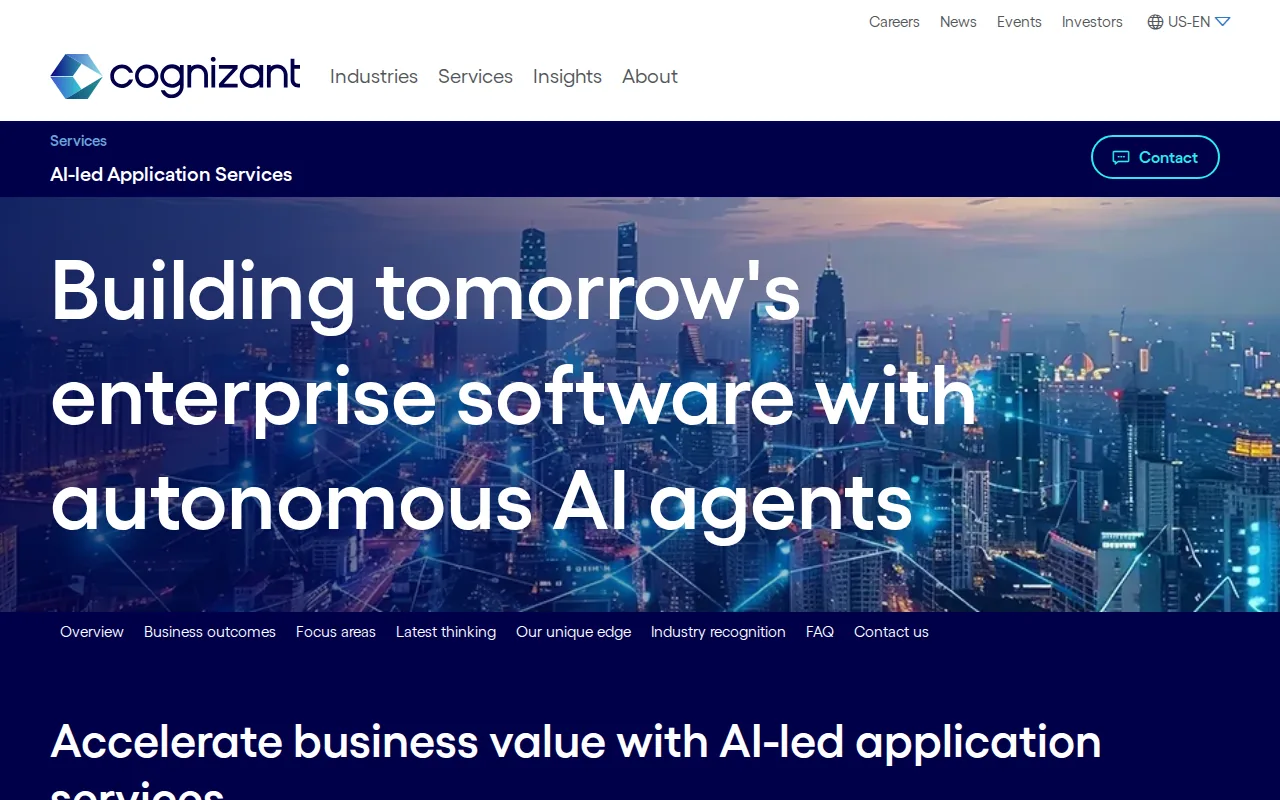
Cognizant, headquartered in Teaneck, New Jersey, sells a dual-track model in which savings from running legacy systems more cheaply fund the transformation under one commercial agreement. It brings its own platforms, Skygrade for cloud-native work and Flowsource for extracting business rules from old code, and describes model-agnostic AI agents for brownfield applications.
Best for: large enterprises that want modernization funded from run-cost savings. Watch for: the return figures on its site are vendor claims, not independent studies.
4. Mechanical Orchard
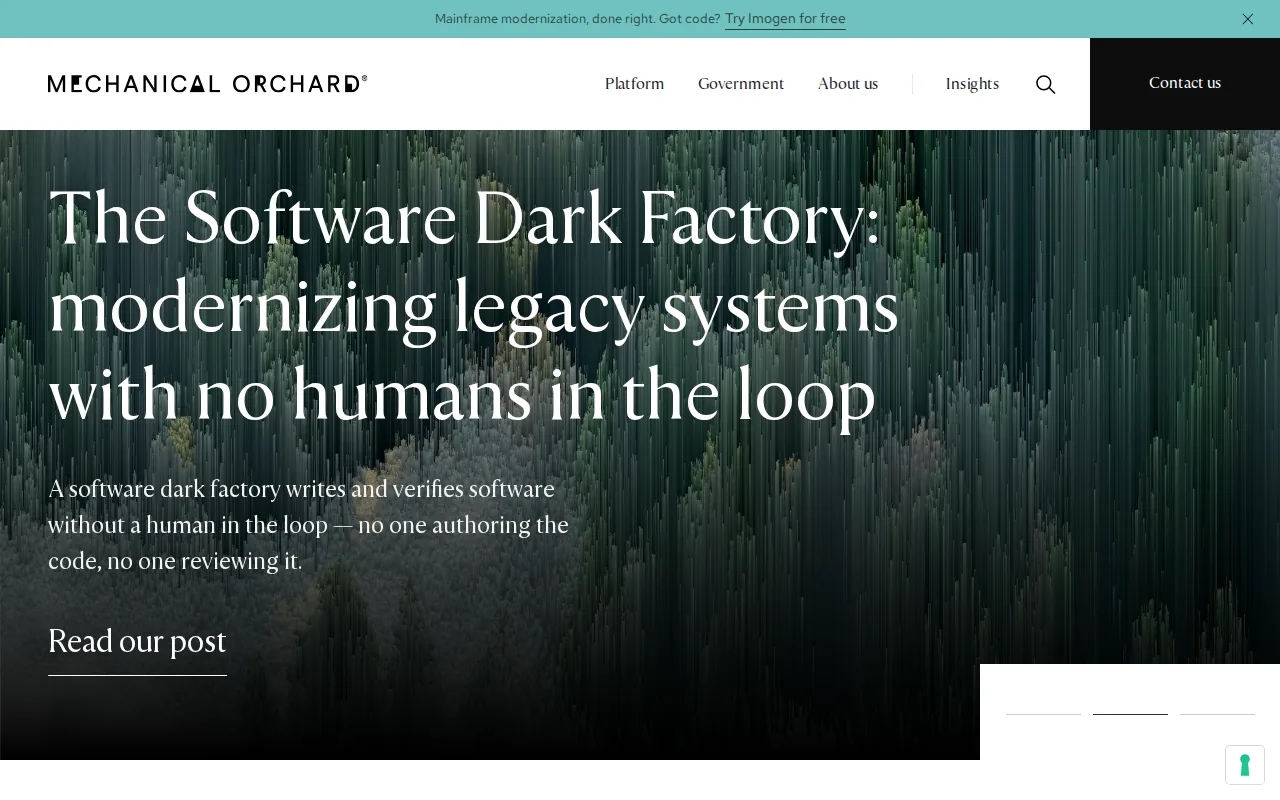
Founded in San Francisco in 2022 by Rob Mee, Mechanical Orchard focuses on AI-driven rewrites of mainframe and other legacy systems. Its Imogen system rewrites legacy code to modern code and verifies behavior continuously against production, which is the most concrete parity approach I found on any vendor site. It offers a free proof of concept on your own code, says Imogen is priced on outcomes, and holds ISO/IEC 27001:2022.
Best for: mainframe and large legacy systems where behavioral parity is the hard problem. Watch for: it is built for big systems, not a 50,000 line PHP portal.
5. vFunction
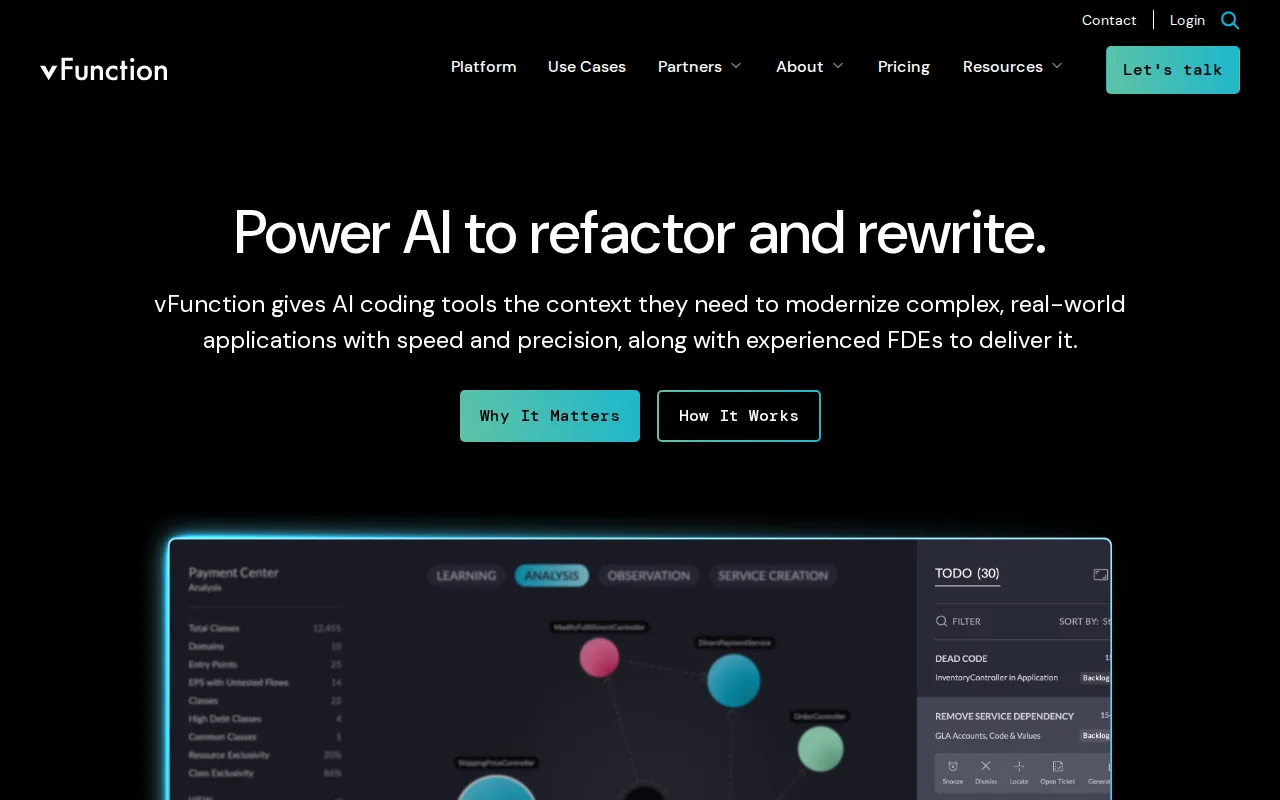
vFunction is tooling rather than a services firm, and it belongs on the list because many services firms use it. It analyzes running Java and .NET monoliths to produce architectural context that guides refactoring, including .NET Framework modernization and SQL Server to PostgreSQL conversion, and it ships with forward-deployed engineers through Azure Marketplace and AWS funded licenses.
Best for: teams that want to keep the work in-house but need an architectural map first. Watch for: it tells you what to change; someone still has to change it.
6. ScienceSoft
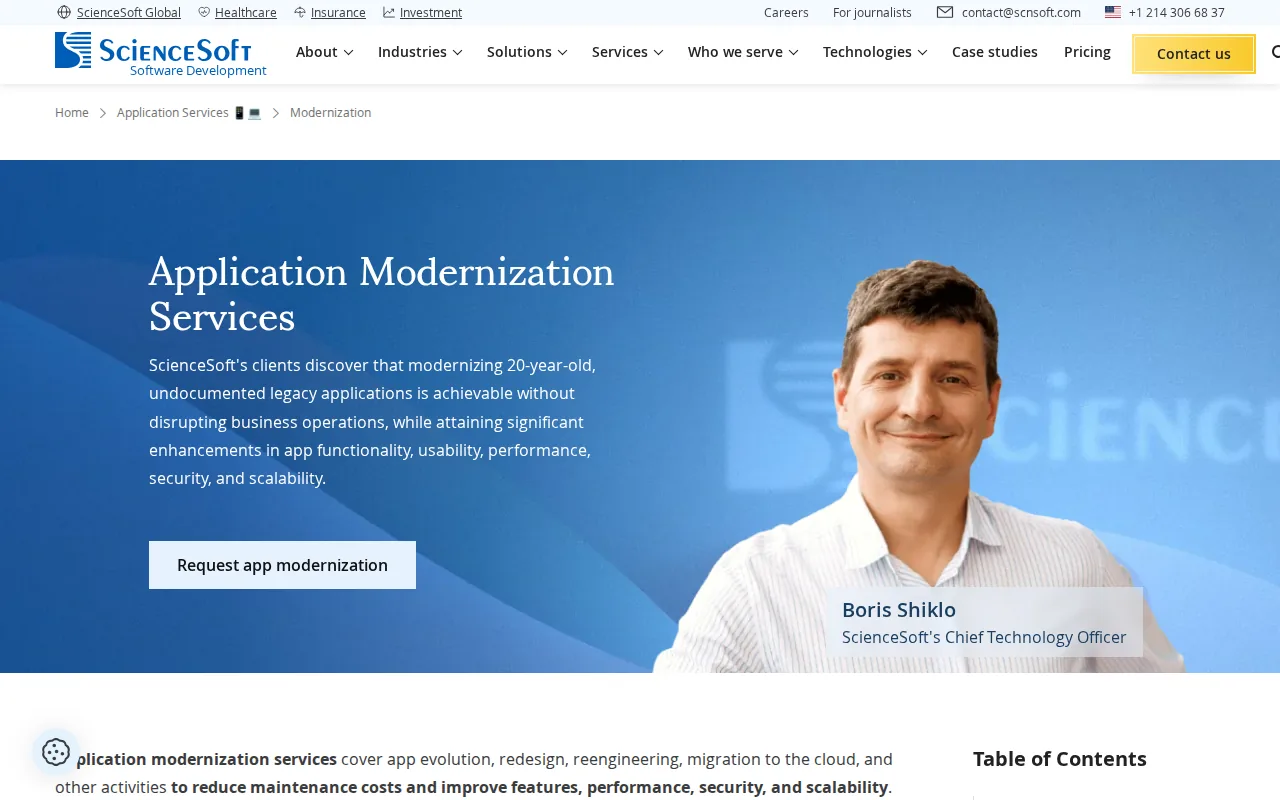
ScienceSoft, based in McKinney, Texas, is one of the few mid-market firms that publishes price ranges by project type on its modernization page. It covers rehost, replatform and cloud-native rebuilds across .NET, Java, Python, Node.js, PHP and Go, uses Ispirer toolkits for database migration, and offers either full outsourcing or team augmentation with a free ballpark estimate within a day.
Best for: mid-market companies that want a quote fast and a conventional outsourcing model. Watch for: who on the delivery team is senior, and where they sit.
7. Taazaa
Taazaa, in Hudson, Ohio, sells dedicated US-based engineering pods for mid-market product and platform work, with legacy modernization under its experience and platform transformation practice. It lists SOC 2 Type 2, ISO 27001 and HIPAA on its site.
Best for: companies that want a US team embedded for the long term, not a project. Watch for: pod pricing is monthly, so define the end state before you start.
8. Saritasa
Saritasa, with offices in Irvine, California and Tampa, Florida, specializes in legacy modernization and what it calls project takeovers: picking up an application another vendor or a departed developer left behind. Its stack list covers Python, PHP and Laravel, Django, .NET, Angular, React, Kotlin and Swift.
Best for: companies whose original developer is gone and whose code needs an owner before it needs a plan. Watch for: takeover work is open-ended by nature, so insist on a scoped first phase.
9. Intellectsoft
Miami-based Intellectsoft leads with an architecture-first approach: a senior architect maps risks and integrations before any code is written, and it can stand up a dedicated team within two weeks. It offers team extension and staff augmentation and is a Microsoft and Google partner.
Best for: companies that want architecture settled before committing a team. Watch for: dedicated teams bill on time, so tie the engagement to milestones.
Which approach each firm is really selling
Modernization is one word for five different projects, and most vendor pages blur them on purpose. Rehosting moves the application to new infrastructure with the code left alone. Replatforming swaps a runtime or database underneath it, say .NET Framework to .NET 8 or an aging SQL Server edition to PostgreSQL, with limited code changes. Refactoring restructures the code while the architecture and the user-facing behavior stay put. Rebuilding replaces the application, or the modules that block the business, against a specification of what the current system does. Replacing retires it in favor of a SaaS product and migrates the data.
Read each firm on this list through that lens. vFunction is an input to refactoring. Mechanical Orchard is a rebuild with a parity engine attached. Cognizant and Accenture will run all five across a portfolio. ScienceSoft prices the first three separately. We do one thing, the rebuild of a bounded custom application, and we say no to the rest. None of these is the right answer in general; each is the right answer for a particular application at a particular age.
A quick way to tell which one you need: ask whether the business rules in the application are still correct. If they are, and the problem is the platform underneath them, replatform or refactor and keep the logic. If the rules have drifted from how the business actually runs, or nobody can say what they are, a rebuild against a fresh specification is cheaper than archaeology. If a competitor could buy the same capability off the shelf, replace it and spend the engineering budget on something only you can build.
What to put in the contract
Whoever you pick, four clauses separate a modernization that lands from one that becomes a line item for three years. First, the commercial model: fixed price per phase with a defined scope beats open-ended time and materials for a bounded application, and any vendor confident in their estimate should accept a penalty for missing the date. Second, ownership: the repository lives in your GitHub or Azure DevOps from day one, nothing proprietary stays in the runtime, and documentation and runbooks are deliverables, not favors. Third, supervision: ask which AI coding tools will be used, whether your code trains anyone’s models, and how a senior engineer reviews generated code before it merges. Unsupervised generation produces software that looks finished and is not. Fourth, parity proof: real production inputs replayed through old and new systems, a parallel run through one full business cycle, and a rehearsed rollback.
Before any of that, decide whether the application should be modernized at all. If a competitor could buy the same capability from a SaaS vendor, so could you; the trade-offs small teams weigh in this comparison of workflow automation tools by B&S Tech Systems scale up to mid-market decisions. Custom code earns its keep only when it encodes how your business actually wins.
If you want a straight answer on one application: A 30-minute call. We’ll tell you if your app fits in 90 days.
How to run the first call with any of these firms
Bring one application, not a portfolio. Name its stack and version, its rough size in lines of code or screens, the number of people who still understand it, and the deadline that is forcing the conversation, whether that is an end-of-support date, an insurance renewal or a departing engineer. A firm that cannot give you a provisional yes or no on fit from that information is going to charge you for the discovery that should have been free.
Then ask three things and listen for specifics. How would you find out what this application actually does today, and what would I get to read before you start writing code? Who on your side writes and reviews the code, and where do they sit? What happens on day 91 if the work is not done? The answers tell you more than the case studies. A firm that leads with a written specification, names its senior reviewers and accepts a penalty for a missed date has priced in the risk you are worried about. A firm that leads with a platform, a methodology name and a dedicated team rate has priced it into your invoice.
Finally, ask for the artifacts from a finished project with the client name removed: a page of the spec, a page of the runbook, the parity test plan. Documents are harder to fake than slides.
Frequently asked questions
What do legacy application modernization services include?
Assessment of the current application, a recommendation among rehost, replatform, refactor, rebuild or replace, the engineering work itself, data migration, parity testing, cutover and handover documentation. Some firms also offer ongoing support or managed services after launch.
How much does legacy application modernization cost?
It depends on the size of the application, the approach and who does the work. A rehost of a small application and a rebuild of a 200,000 line system are different orders of magnitude. Ask each firm for a fixed quote against a written scope rather than an hourly rate, and compare the terms as closely as the number.
How long does it take?
A rehost can take days, a replatform weeks, and a supervised spec-driven rebuild of a 20,000 to 200,000 line application about 90 days. Programs quoted in years are portfolios, not applications, and should be broken into application-sized pieces.
Should we use a global integrator or a specialist firm?
Match the firm to the size of the problem. Multi-million-line estates with dozens of systems need the coverage of an Accenture or Cognizant. A single custom application at a mid-market company is usually better served by a specialist that puts senior engineers on it and leaves you owning the result.
Is AI-assisted development safe for modernization?
Yes, when it runs against a written specification and a senior engineer reviews every commit. The speed is real; the risk is unsupervised generation that passes a demo and fails in production. Ask any vendor to show you their review process, not just their tools.
What should we own at the end of the project?
All of the code, in your own repository, with no proprietary runtime or license left behind, plus architecture documentation, runbooks and a warranty period. Put each of those in the contract.