

Custom Software Development Company: 9 Firms Compared


Most lists of custom software development companies are written by one of the companies on the list, and the ranking tells you more about who wrote the page than about who should build your software. I run one of the firms below, so take that into account. What I have tried to do differently is keep every entry to facts you can check: where the firm is based, when it was founded, roughly how many people it employs, who it names as clients, and how it structures an engagement. Where a firm publishes its own pricing, I link to the page. Where it does not, the cell stays blank.
This list is for a CTO, VP of Engineering or technical founder who wants to shortlist a custom software development company in the United States without reading forty agency pitches. All nine firms are US-headquartered. Several deliver mostly from offshore or nearshore teams, and I say so where it is the case, because it changes how you manage the work.
How I chose the firms on this list
Every firm here builds software for clients as its main business. No SaaS products, no marketing platforms, no freelancer marketplaces. Each entry had to pass a simple test: at least two concrete facts about the firm from a page other than its own marketing copy, such as a founding date, a street address, a headcount range or a named client. Sources are the firms’ own company pages, Clutch profiles, Wikipedia, Built In and a chamber of commerce listing.
I dropped one firm during research because its domain now redirects to an unrelated financial services site. A listicle from 2023 is not evidence that a company still exists, so check the homepage before you email anyone.
The order is not a ranking. LoadSys is first because it is mine and I would rather say that plainly than pretend otherwise. The other eight run roughly from boutique teams to firms with thousands of engineers, since team size is usually the first filter a buyer applies.
Side-by-side comparison
| Firm | Headquarters | Founded | Team size (source) | Engagement model | Published pricing |
|---|---|---|---|---|---|
| LoadSys Solutions | Chicago, IL | 2002 | Fixed-price 90-day modernization; AI engineering projects, agent development and team training | ||
| Atomic Object | Grand Rapids, MI | 2001 | 140+ (firm) | Fixed budget, scope controlled | $50k to over $1 million per project |
| Pell Software | Denver, CO | 2019 | 10 to 49 (Clutch) | Hourly with itemized billing, or fixed cost | |
| Zco Corporation | Nashua, NH | 1989 | 250+ (firm) | Dedicated developers, team augmentation | |
| DOOR3 | New York, NY | 2002 | 50 to 249 (Clutch) | Advisory, buildout, project rescue | |
| Vention | New York, NY | 2002 | 3,000+ (firm) | Dedicated teams, staff augmentation | |
| Intellectsoft | Miami, FL | 2007 | 50 to 249 (Clutch) | Dedicated team, staff augmentation, fixed scope | |
| ScienceSoft | McKinney, TX | 1989 | 750+ (firm) | Time and materials, T&M with cap, fixed price | |
| Very | Bozeman, MT (distributed) | 2011 | 50 to 249 (Clutch) | Fixed-price sprints, T&M consulting, augmentation |
For a blank pricing cell, ask the firm for its rates and minimums directly. Review directories list hourly bands for most of these firms, but those figures are self-reported and often stale, so I have not repeated them.
1. LoadSys Solutions
LoadSys Solutions is the firm I run. We are a Chicago-based AI engineering and custom software consultancy, in business since 2002, with more than 400 clients over that time, including Stanford University. We are an Anthropic Partner, which in practice means our engineers work with Claude Code daily and we are candid about where it helps and where it does not.
The practice has six service lines: AI-Assisted Development, where our senior engineers build custom software with AI coding agents (Claude Code, Cursor, Copilot) run against a written specification; Dev Team Training on AI Best Practices, for engineering teams that want to adopt those tools without the quality drop; MCP Setup, connecting your databases and internal systems to AI through the Model Context Protocol; AI/LLM Integration into Business Processes; AI Agent Development, meaning production agents with monitoring and evaluation rather than demos; and Claude Expertise across the Anthropic ecosystem. All of it runs on Spec-Driven Development, a Plan, Execute, Verify workflow that we also ship as Brunel, our AI development planning platform.
The engagement most buyers of this list ask about is Custom Application Modernization: legacy applications of roughly 20,000 to 200,000 lines of code, rebuilt in 90 days at a fixed price. The spec comes first, AI-assisted development runs against it under senior engineer supervision, and every commit is reviewed by a human before it merges. If we miss the 90-day deadline, 25 percent of the fee is forgiven. You own 100 percent of the code, you get architecture documentation and runbooks, and there is a 60-day bug-fix warranty after delivery.
Who it fits: mid-market companies with an internal tool, portal, operational system or vertical SaaS product on an aging stack (PHP, Rails, .NET Framework, AngularJS); engineering teams moving AI from pilots into production systems; and startups that built a product with AI tools and now need it production-ready. Who it does not fit: multi-million-line enterprise rebuilds, deeply regulated rebuilds or terabyte-scale data migrations. We say no to those.
2. Atomic Object
Atomic Object was founded in Grand Rapids, Michigan in 2001 by Carl Erickson and Bill Bereza and is employee-owned. Its team page lists more than 140 people and 74 employee owners across four offices: Grand Rapids, Ann Arbor, Chicago and Raleigh-Durham. Client logos include Ford, Cleveland Clinic, Qualcomm and Bosch, and its Clutch profile shows a stack centered on Ruby on Rails, React, Node.js and TypeScript.
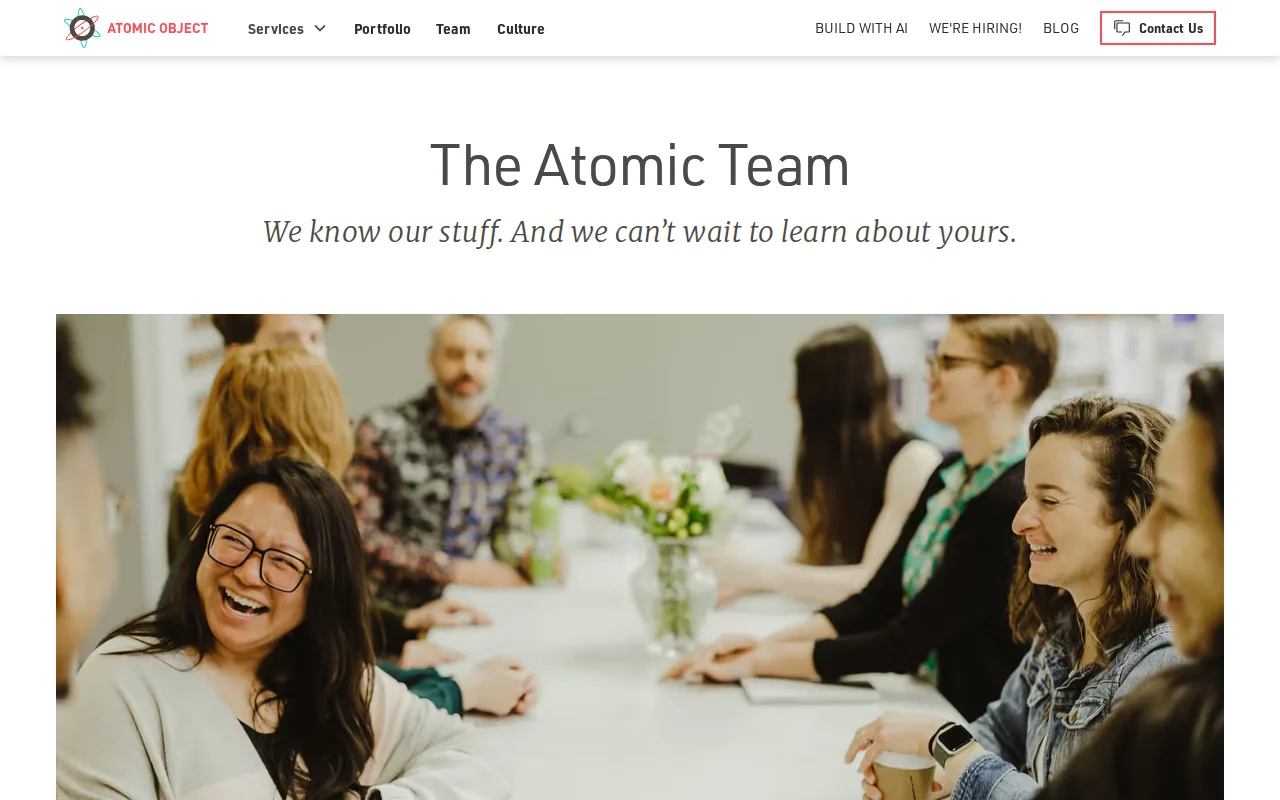
The most useful thing about Atomic Object for a buyer is that it explains its commercial model in writing. Its page on money describes a model it calls Fixed-Budget, Scope-Controlled: you agree a budget and scope flexes inside it. The same page states that projects usually run 3 to 18 months with budgets from $50,000 to over $1 million.
Who it fits: product companies and healthcare or financial services organizations that want a US-based, employee-owned team to design and build a new product, or modernize an existing one, over a multi-quarter engagement.
3. Pell Software
Pell Software is a boutique firm in Denver, founded in 2019, with a team of about 15 named people on its about page, which also states that the firm operates only inside the United States with no international affiliates. Its named clients are mostly industrial and construction businesses: Rohrer Corporation, GH Phipps Construction Companies, Select Sand & Gravel and FieldFlo. The stack is Microsoft through and through: .NET, C#, ASP.NET Core, TypeScript, Azure and Azure SQL, with integrations into QuickBooks, Sage, NetSuite and Shopify.
Pell’s pricing page explains how billing works: hourly engagements come with itemized hour reports on every invoice, and fixed-cost projects are quoted as a single price. That level of billing transparency is rarer than it should be.
Who it fits: owner-led companies in construction, manufacturing or distribution that need a custom CRM, ERP module or integration on a Microsoft stack, want an all-US team, and prefer a small firm where the people who scoped the work write the code.
4. Zco Corporation
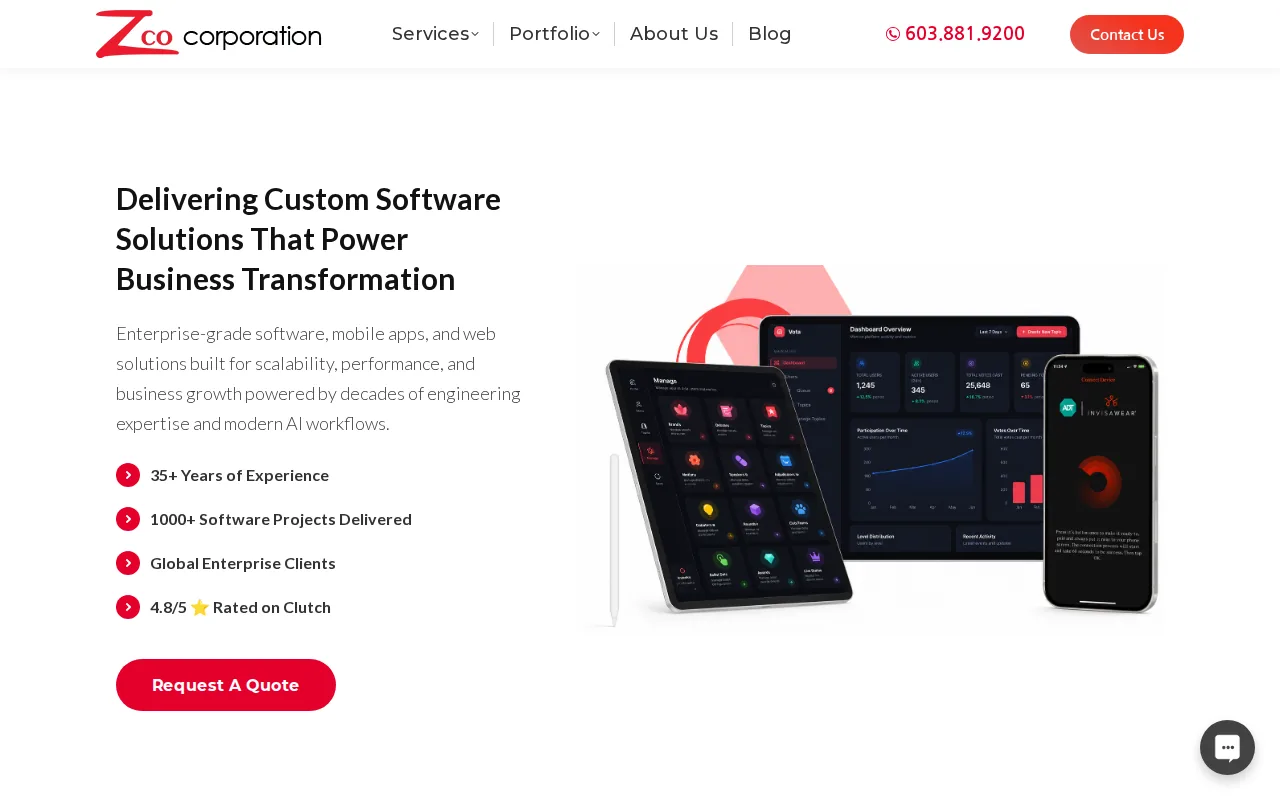
Zco is one of the oldest firms on this list. Its about page says John Olapurath founded the company in 1989, and the Nashua Chamber of Commerce listing confirms the founding year and the address at 20 Trafalgar Square in Nashua, New Hampshire. The firm reports more than 250 staff, with satellite offices in Boston and New York. Its Clutch profile names Volkswagen, Microsoft, Harvard University and BBC America among clients, and its service mix leans toward mobile, at roughly 40 percent of the work.
The stack list is long: Swift, Kotlin, React Native, Flutter, Unity, .NET Core, Java, Go, PHP and Node.js. Engagements run as dedicated developers or team augmentation, with a proposal and cost estimate before development starts.
Who it fits: companies whose project is mobile-first, or who need a consumer or AR app built alongside a backend, and who want a long-established US firm with a large bench.
5. DOOR3
DOOR3 was founded in 2002 and is headquartered at 370 Lexington Avenue in New York City, according to its about page, which also lists a delivery center in Kyiv and offices in Barcelona and Zurich. Clutch puts the firm at 50 to 249 people, most of them in New York. Named clients include PepsiCo, AIG, Munich Re and Johnson & Johnson, and the firm’s service mix on Clutch splits almost evenly between AI consulting, custom software and UX/UI design.
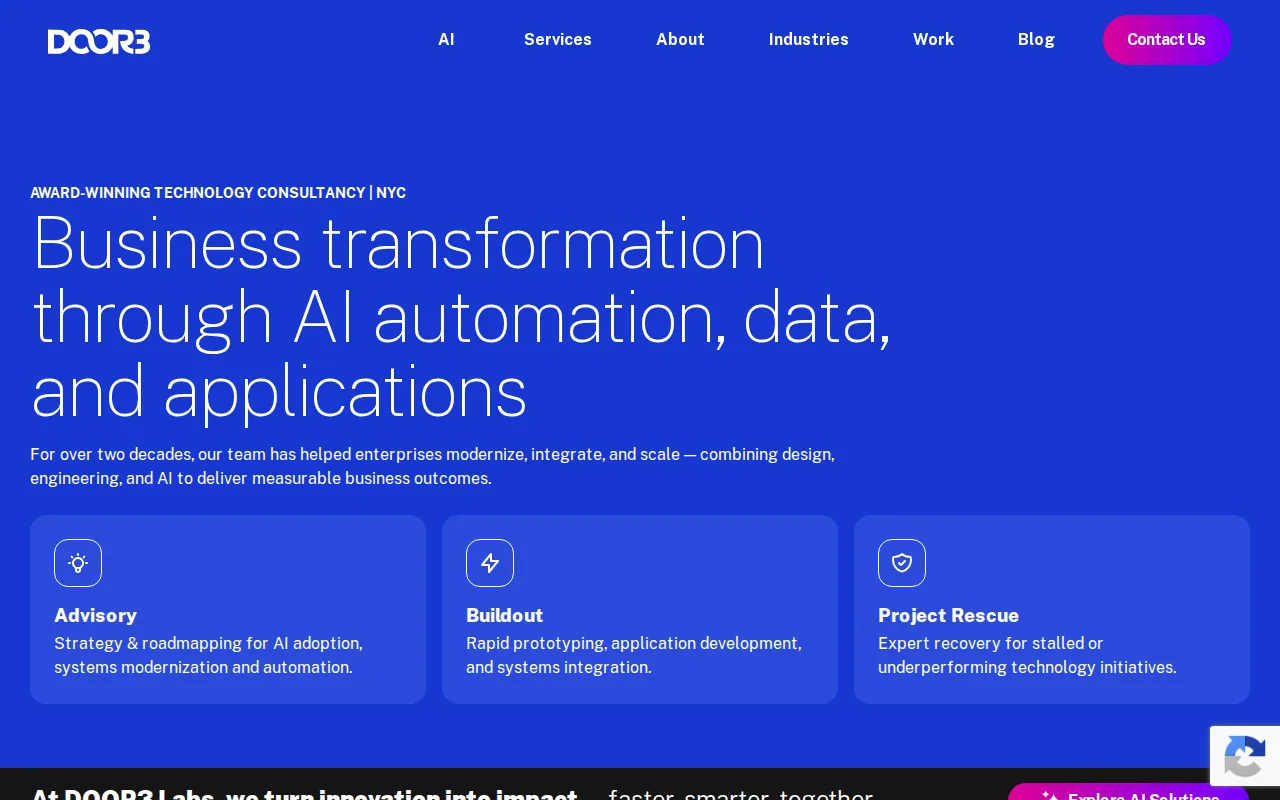
DOOR3 sells three entry points: Advisory (CTO-level strategy and roadmapping), Buildout (prototyping, development and integration) and Project Rescue for stalled initiatives. Few firms advertise a rescue practice, and if you are inheriting a half-finished build from a previous vendor, a firm that does this routinely will ask better questions in the first meeting.
Who it fits: enterprises in insurance, financial services, legal or manufacturing that need design and engineering under one roof, or that have a troubled project in flight.
6. Vention
Vention is the largest firm here by headcount. Its company page states a team of more than 3,000, headquartered at 575 Lexington Avenue in New York with more than 20 offices, and gives 2002 as the founding year. CB Insights records that the firm was formerly known as iTechArt, the name it carried until a 2023 rebrand. Named clients on its site include IBM, PayPal, PwC, Mount Sinai and ClassPass. The firm says its average engagement runs 28 months with an average team of seven.
Vention’s model is dedicated teams and staff augmentation, scoped individually, with discovery workshops before a build. The engineering bench sits largely outside the US, so this is a nearshore and offshore engagement managed from New York. Stack coverage is broad: Java, Node.js, React, Python, Go, .NET, Angular, Flutter and React Native, with AWS as the most common cloud.
Who it fits: funded startups and enterprises that need to add a full product team quickly, keep it for a year or more, and already have in-house technical leadership to direct it.
7. Intellectsoft
Intellectsoft was founded in 2007, per its Clutch profile, and is now headquartered at 8 SW 7th Street in Miami, with a London office, according to the firm’s contact page. Older directory listings still show Palo Alto. Clutch describes it as a roughly 230-person engineering company with delivery teams across Eastern Europe, Latin America and Asia-Pacific. Named clients include Eurostar, Jaguar, NBC Universal, Ernst & Young and Harley-Davidson.
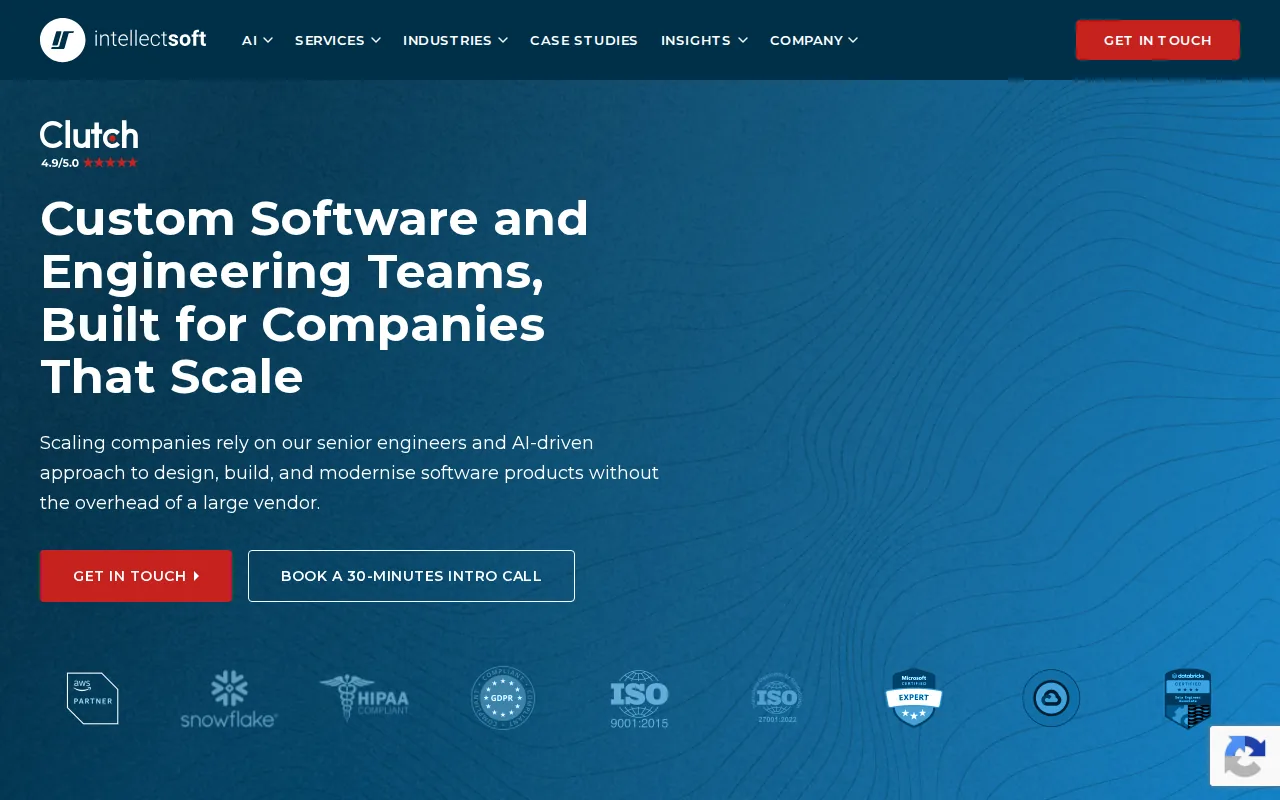
Its dedicated team page offers three engagement shapes: a dedicated team, staff augmentation, and a fully managed project with fixed scope, with the option to switch between the dedicated and fixed-scope models mid-engagement. The stack is wide (React, Angular, Node.js, Python, Java, Go, .NET, Kubernetes, Terraform).
Who it fits: mid-size companies that want a managed, fixed-scope delivery with the option to convert to a standing team afterward, and are comfortable with a mostly offshore engineering bench.
8. ScienceSoft
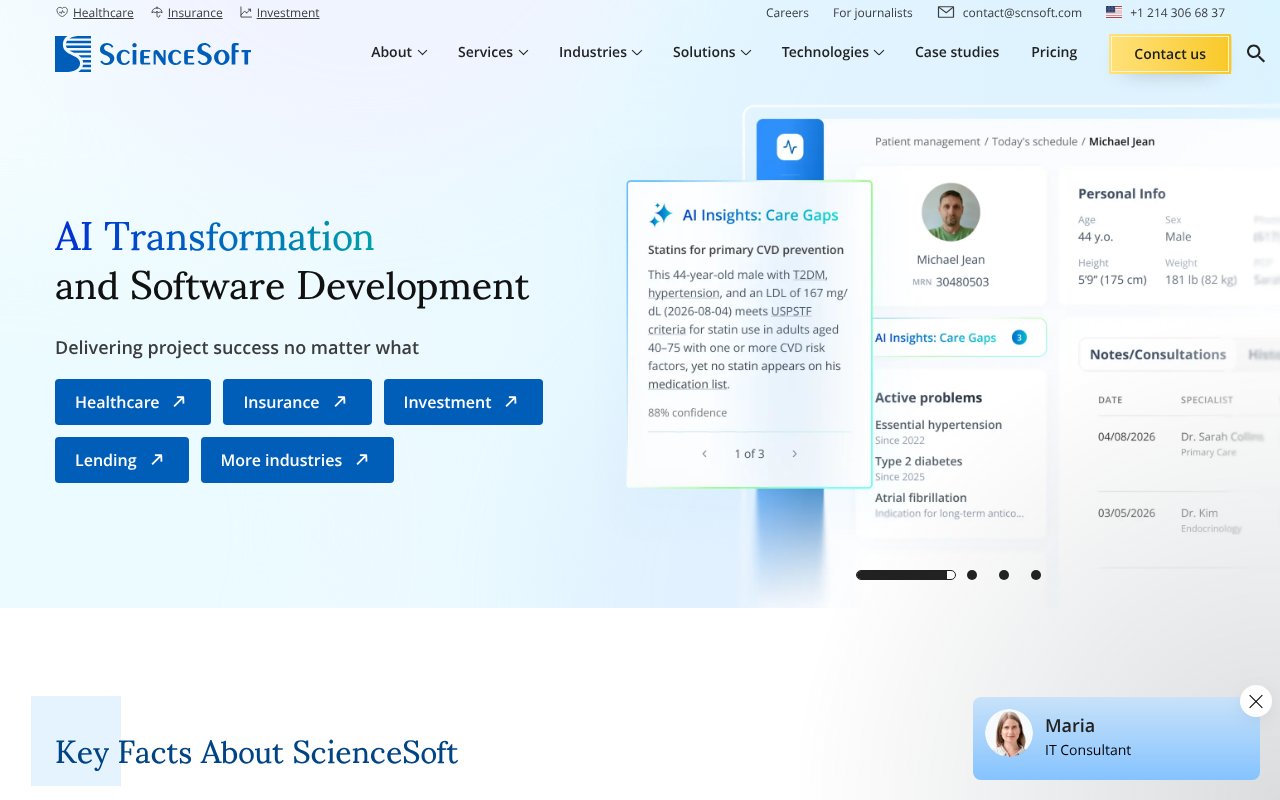
ScienceSoft dates to 1989 and is headquartered at 5900 S. Lake Forest Drive in McKinney, Texas, with a reported team of more than 750, according to its contact page. The firm’s 2015 announcement of the Texas office notes it was then headquartered in Helsinki and names eBay, PerkinElmer and IBM as clients. Other offices include Atlanta, Mexico City, Riga, Warsaw and Fujairah. Industry focus is healthcare, insurance, investment and lending.
ScienceSoft is unusual in publishing a pricing models page. It states that more than 90 percent of its development projects run on time and materials, with T&M with a cap and fixed price as alternatives. If you want a fixed price from this firm, you will be in the minority of its projects.
Who it fits: organizations in regulated verticals that want a large vendor with a long track record and are prepared to manage a time-and-materials engagement with a mostly non-US team.
9. Very
Very is the specialist on this list. Its about page gives 2011 as the founding year and lists IoT platform development, hardware and firmware, embedded systems, wireless design and AI agents as its practice areas. Built In describes it as a fully distributed firm of about 145 people headquartered in Bozeman, Montana. Logos on its site include Vizio, HP, L’Oreal, Texas Instruments and iHeartMedia, and its Clutch profile shows Elixir, C, C++, Python and React Native in the stack, with AWS as the primary cloud.
Very’s engagements come in four shapes: time-and-materials consulting, fixed-price sprints of one to five weeks, longer product partnerships, and team augmentation with a four-week minimum.
Who it fits: companies building a connected product where the firmware, cloud backend and mobile app have to be designed together. If your project has no hardware in it, one of the other eight firms is a closer match.
How to read the engagement models
The engagement column matters more than the headcount column, because it decides where the risk sits.
Time and materials puts the risk on you. You pay for hours, the scope can move, and the vendor’s incentive is to keep the team billing. It is the right model when you cannot write down what you want yet, or for open-ended maintenance. It is the wrong model for a bounded rebuild where you already know what the system has to do, because you have handed over the one lever that controls cost.
Fixed price puts the risk on the vendor, which is why most vendors avoid it or pad it. It only works when the scope is written down well enough that both sides can point to the document and say whether a feature is in or out. A fixed price without a spec is a guess with a signature on it.
Fixed budget with controlled scope, the Atomic Object model, is a sensible middle ground for new product work. Dedicated teams and staff augmentation are not project models at all; they are a way to rent engineers, and they only work when you have a strong technical lead to direct them.
One number to keep in mind when a vendor tells you senior engineers are scarce: the Bureau of Labor Statistics projects that employment of software developers, quality assurance analysts and testers will grow 10 percent from 2025 to 2035, with about 106,100 openings a year. Demand is real, which is also a reason to doubt any firm claiming hundreds of idle senior people waiting for your call.
The question to ask every firm about AI coding
Every firm on this list now says it uses AI in development. That tells you nothing. The question that separates them is: who reviews what the AI writes, and against what?
The 2025 Stack Overflow Developer Survey found that 84 percent of developers use or plan to use AI tools, while 46 percent actively distrust the accuracy of those tools, and the single most common frustration, cited by 66 percent, is AI output that is almost right but not quite. That last figure is the whole problem. Code that is almost right compiles, passes a demo and fails in production three weeks later. I call this the completion illusion: the feature looks done, the ticket gets closed, and nobody has verified the edge cases.
The defense is procedural. Our rule is that the AI works against a written specification, every commit is reviewed by a senior engineer before merge, and the spec itself is the acceptance test. Ask any custom software development company to describe its review process for AI-generated code in that much detail. If the answer is “our engineers check it,” ask what they check it against. Without a written spec, the real answer is their memory of a conversation.
Rebuild, modernize or replace: decide this first
Before you shortlist vendors, settle which kind of project you are running. Many expensive engagements start with the wrong framing.
If you are replacing a custom application with an off-the-shelf SaaS product, you do not need most of the firms above; you need an integration partner and a data migration plan. I wrote about how that calculation shifted in rebuild or replace with SaaS, and the short version is that AI-assisted rebuilds have made keeping a custom system viable in cases where, two years ago, the SaaS option won by default.
If you have a working custom application on an end-of-life stack, the project is modernization, not greenfield development, and the vendor’s experience with legacy code matters more than its design portfolio. PHP’s supported versions page is a good place to check whether your runtime still receives security fixes; the same question applies to .NET Framework, Rails and AngularJS. For that kind of project, I keep two other comparisons current: legacy application modernization companies compared by stack and delivery model, and a breakdown of modernization services by pricing model, code ownership and how AI coding is supervised.
If you are a startup with an MVP built on AI tools and you need it hardened for paying customers, that is a third kind of project again. Getting that first version production-ready is the work we do on the startup side.
Questions to settle before you sign
Code ownership. The contract should say you own 100 percent of the code, the infrastructure configuration and the documentation from the first commit, not on final payment. Make sure it is in the agreement, not just on the website.
Who writes the code. Ask for the names and locations of the engineers who will be on your project. A New York headquarters with a Kyiv or Mexico City delivery center is a legitimate model, but you should know it before the kickoff call spans three time zones.
Secrets and credentials. Ask how the firm handles API keys and cloud credentials during development, and whether it scans repositories for leaked secrets before handoff.
Documentation and handoff. Architecture documentation, runbooks and a deployment guide should be deliverables with their own acceptance criteria, not an afterthought in the final week.
Warranty and penalties. What happens when a bug appears after launch, and what happens if the deadline slips? Ask for both in writing. A firm that will not put a consequence on its own deadline does not believe in it either. And if your cyber insurance renewal asks about unsupported software, find out whether the vendor’s delivery leaves you with a stack you can answer for.
If your application is in the 20,000 to 200,000 line range and the project is modernization rather than greenfield, the fastest way to find out whether it fits our model is simple. A 30-minute call. We’ll tell you if your app fits in 90 days.
Frequently asked questions
What does a custom software development company actually do?
It designs, builds, tests and usually maintains software written for one client, as opposed to selling a packaged product. Work ranges from a single integration to a full internal operating system. Most firms also offer discovery, UX design, cloud infrastructure and support, and the mix varies, which is why the engagement model matters more than the service list.
How much does custom software development cost?
Atomic Object states on its own site that projects usually run from $50,000 to over $1 million. Get a written quote tied to a written scope, and be wary of a fixed price offered before anyone has read your codebase.
Should I choose a US-based firm or an offshore one?
Choose based on who will manage the engineers. If you have a strong technical lead in-house, a dedicated offshore or nearshore team from a firm like Vention or Intellectsoft can work well. If you do not, a US-based firm that owns the outcome on a fixed scope is usually safer, because you are buying judgment, not just hours.
How do I check whether a development company is legitimate?
Confirm the founding year and address on a third-party source such as a state business registry, a chamber of commerce listing or Clutch, confirm that the homepage still loads and belongs to the firm, and ask to speak to a named client from the last twelve months. One firm on my original list of ten failed the second test.
Is modernization different from custom software development?
Yes. Modernization starts from a working system with years of business rules embedded in it, and the main risk is losing behavior nobody documented. Greenfield development starts from a blank repository, and the main risk is building the wrong thing. Ask for examples of the kind of project you actually have.